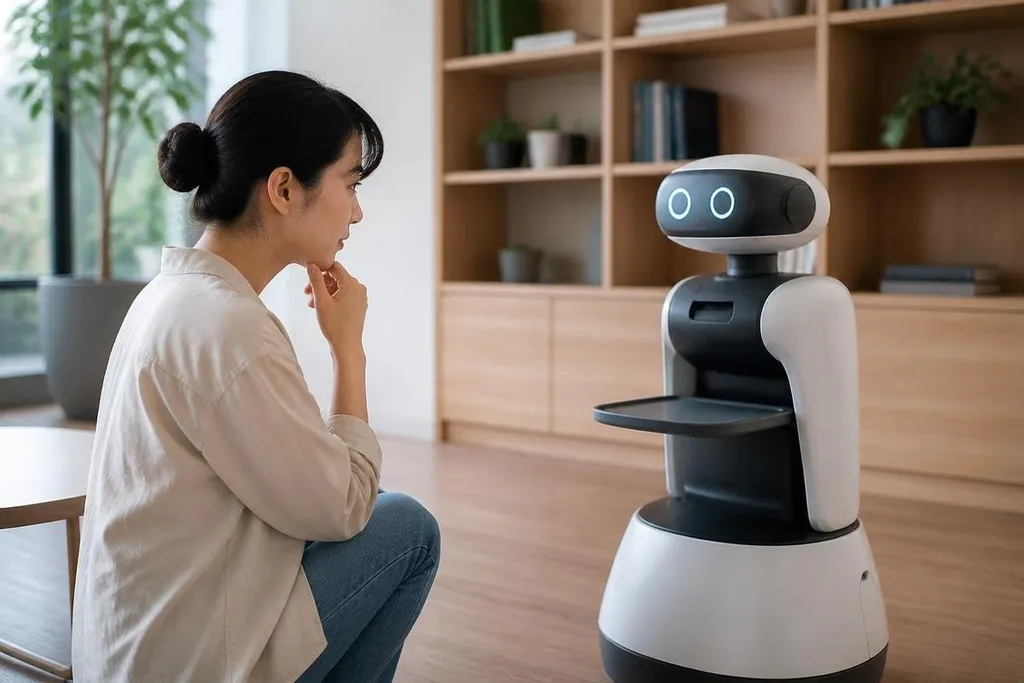
A robot can change how people feel before it proves what it can do. Its face, voice, movement, and timing can make a person treat it as a tool, a helper, or a social partner.
For teams building or buying autonomous systems, the useful question is not whether a robot has feelings. It’s why people assign feelings, intentions, or duties to a machine that has none.
Quick read
- Human-like movement can make people expect human-like care.
- Trust grows from clear behavior, not a friendly voice alone.
- A robot should show its limits before people depend on it.
People read intent into movement
People often judge a machine by the way it moves. Turning toward someone before speaking may seem attentive. Pausing before reaching for an object may seem careful, even when both actions come from fixed software rules.
This response is called anthropomorphism: treating a nonhuman thing as if it has human traits. It can help people learn a system faster because familiar social signals give them clues about what may happen next. It can also create false expectations about judgment, care, or responsibility.
The risk rises when a robot uses a face, a name, or a human-style voice. Those features can make an interaction feel personal, while the system may still fail on an unusual request or miss a safety hazard.
The design has to keep the social signal close to the machine’s real ability.
Trust depends on what the robot shows
Trust is built through repeated, understandable behavior. A warehouse robot that stops at the same marked zone each time gives an operator a reason to rely on it. A service robot that explains why it stopped gives the person a way to choose the next action.
This is where transparency matters. The robot doesn’t need to expose its entire software stack. It does need to show whether it heard a command, lost a sensor reading, needs help, or has reached the edge of its operating area.
A pleasant voice can’t repair unclear behavior. If the system says it has completed a task when it only sent a request to another machine, people may form the wrong view of its ability. That error can spread from one worker to the next through normal use.
That trust can change how closely people check a robot’s work. Robot24.com robotics coverage can connect a robot’s social cues to its actual task, so the next section can examine how social behavior changes the job around it.
Social behavior changes the job around the robot
A human-shaped body isn’t required for a robot to affect a team. Workers may give it a name, speak to it during faults, or change their route around it. These actions can make the system easier to accept, but they can also hide who remains responsible for the work.
The effect matters in care, education, and public spaces. A person may tell a robot something they wouldn’t tell a screen because the robot appears to listen. That creates a duty to explain what data the system records, where it goes, and who can access it.
The same issue applies to refusal. If a robot declines a request with a calm voice and a clear reason, people can treat the refusal as part of the task. If it refuses without an explanation, they may blame the wrong component or try unsafe workarounds.
I’d skip human-like social features when they hide weak sensing or poor task control. A plain machine that states its limits can earn more useful trust than a warm machine that leaves people guessing.
Before you deploy a social robot
Use this checklist when a system will work near people or ask them to rely on its decisions:
- Name the task: Write down what the robot may do and what stays with a person.
- Show system state: Give visible or spoken signals for waiting, working, stopping, and failure.
- Test unusual requests: Include unclear commands, blocked paths, noise, and missing objects.
- Set data rules: Tell people what the robot records and how long the records remain.
- Check the social signal: Remove a face, voice cue, or gesture if it promises more judgment than the robot has.
These checks connect the machine’s social behavior to its real operating limits. That connection matters more than making the interaction feel human.
The next useful test for any human-robot relationship is plain: after a failure, can a person tell what happened and what to do next? If the answer is no, the robot is asking for trust it hasn’t earned.